The English Shepherd
One of America's oldest and most capable heritage breeds — intelligent, loyal, and built for a life of purpose.
A True Heritage Breed
The English Shepherd is not a newcomer. Long before dog shows and breed registries, this dog was simply the one you'd find on every working farm across the eastern United States — herding livestock, hunting vermin, keeping watch, and sleeping at the feet of the family at the end of a long day. They were bred entirely for function, and it shows.
That singular focus on ability rather than appearance is exactly what makes the English Shepherd so special. They haven't been watered down by decades of show-ring selection. What you get is the real thing — a dog that was built to work, built to think, and built to bond deeply with the people it calls its own.
At Hickory Hill, this is exactly why we chose the breed. We wanted a dog with substance — one that could live and work alongside us on our Tennessee property and still be a devoted, trustworthy family dog at the end of the day. The English Shepherd delivers on both counts without compromise.
Where They Come From
The ancestors of the English Shepherd were the working collies brought to North America by early settlers from Britain and Ireland, beginning in the 1800s. Over more than a century, these dogs spread across the eastern states and became the defining farm dog of rural American life — so common and consistent in type that they were the dog Norman Rockwell painted when he painted a farm dog.
This same ancestry connects them to the modern Border Collie, Rough Collie, and Australian Shepherd. But while those breeds were increasingly shaped by sheepdog trials and conformation shows, the English Shepherd stayed on the farm. Farmers had no interest in flash. They needed a dog that could herd in the morning, hunt in the afternoon, guard the property at night, and love the children all day long. That practical selection pressure is what shaped the English Shepherd into what it is today.
The United Kennel Club (UKC) has been registering English Shepherds since 1927 — originally under the name American Farm Shepherd, renamed in 2003. The breed is also registered with the English Shepherd Club, founded in 1954, which maintains its own open registry. The English Shepherd is not recognized by the AKC, and most breeders and enthusiasts see that as a feature, not a flaw.
What They're Like to Live With
The English Shepherd is deeply intelligent — the kind of dog that watches what's happening around it and draws its own conclusions. They learn routines quickly, anticipate what you want, and can work independently in ways that still surprise even experienced dog owners. People describe them as having an almost uncanny ability to read a situation.
They are loyal in a way that goes beyond obedience. Many English Shepherds pick a person — a "their person" — and maintain that bond for life. They are not aloof, but they are discerning. Once an English Shepherd trusts you, you have a devoted companion that will want to be wherever you are.
One trait worth understanding before you get one: English Shepherds are rule-oriented. They have a natural sense of how things should be, and they take that seriously. This makes them excellent at their jobs and very trainable — but it also means they need structure, clear leadership, and a home that channels their energy and intelligence purposefully. A bored or under-stimulated English Shepherd will find ways to stay busy that you may not appreciate.
They are not always immediately warm to strangers, and some individuals are more territorial than others. Early socialization goes a long way in shaping how this natural wariness expresses itself. A well-socialized English Shepherd is confident and steady around new people — cautious but not fearful, watchful but not reactive.

How They Compare
If you're already familiar with Border Collies or Australian Shepherds, you may wonder how the English Shepherd fits alongside them. The short answer is that the English Shepherd shares much of the same intelligence and drive — but carries a quality those breeds often lack: an off switch.
Border Collies and Aussies, especially lines bred for competition, can be relentlessly intense. They need a job constantly or they struggle. The English Shepherd has that same capability and work ethic, but knows how to settle. They can work hard all morning and spend the afternoon quiet at your feet. That balance is rare in a working breed, and it's a big part of why English Shepherds make such good family dogs in addition to everything else they do.
Their herding style also differs. English Shepherds are natural upright, loose-eyed workers — they move stock with presence and confidence rather than the intense, crouching eye-style of the Border Collie. They are versatile enough to work cattle, sheep, poultry, or hogs, and they bring just the right amount of pressure for each.
Similar intelligence and herding ability, but the English Shepherd is calmer in the home, less obsessive, and better suited to multi-role farm life rather than single-minded trial work.
Both are versatile and athletic, but English Shepherds tend to be more independent thinkers, quieter in temperament, and carry less of the high-strung energy often found in modern Aussie lines.
They share ancestry, but the English Shepherd is a working dog first — more athletic, more driven, and built for a life of activity rather than the more decorative role the Rough Collie has largely been bred into.
What They're Capable Of
The English Shepherd's versatility is not just a historical footnote — it shows up every day in the lives of people who own them. Here are some of the roles English Shepherds fill:
Their natural instinct. English Shepherds work cattle, sheep, hogs, goats, and poultry with an upright style and steady confidence that requires minimal training to bring out.
English Shepherds are natural trackers and have historically been used for hunting and treeing small game. Their nose and drive make them excellent in the field.
They take their job as protector of home and property seriously. Not aggressive by nature, but watchful, alert, and territorial enough to be an effective deterrent.
English Shepherds have excelled at agility, obedience, flyball, nosework, disc dog, dock diving, barn hunt, and tracking. Their athleticism and trainability make them standouts.
Their intelligence, drive, and nose have made them effective search and rescue dogs. Many certified SAR dogs in the US are English Shepherds.
With proper socialization, their calm attentiveness and loyalty make them wonderful therapy dogs in hospitals, nursing homes, and schools.
Perhaps their most common modern role. An English Shepherd in the right home — active, engaged, consistent — is an extraordinary family dog unlike any other breed.
An often-overlooked working role. English Shepherds are natural ratters and have historically kept barns and properties free of mice, rats, and other pests.
What They Look Like
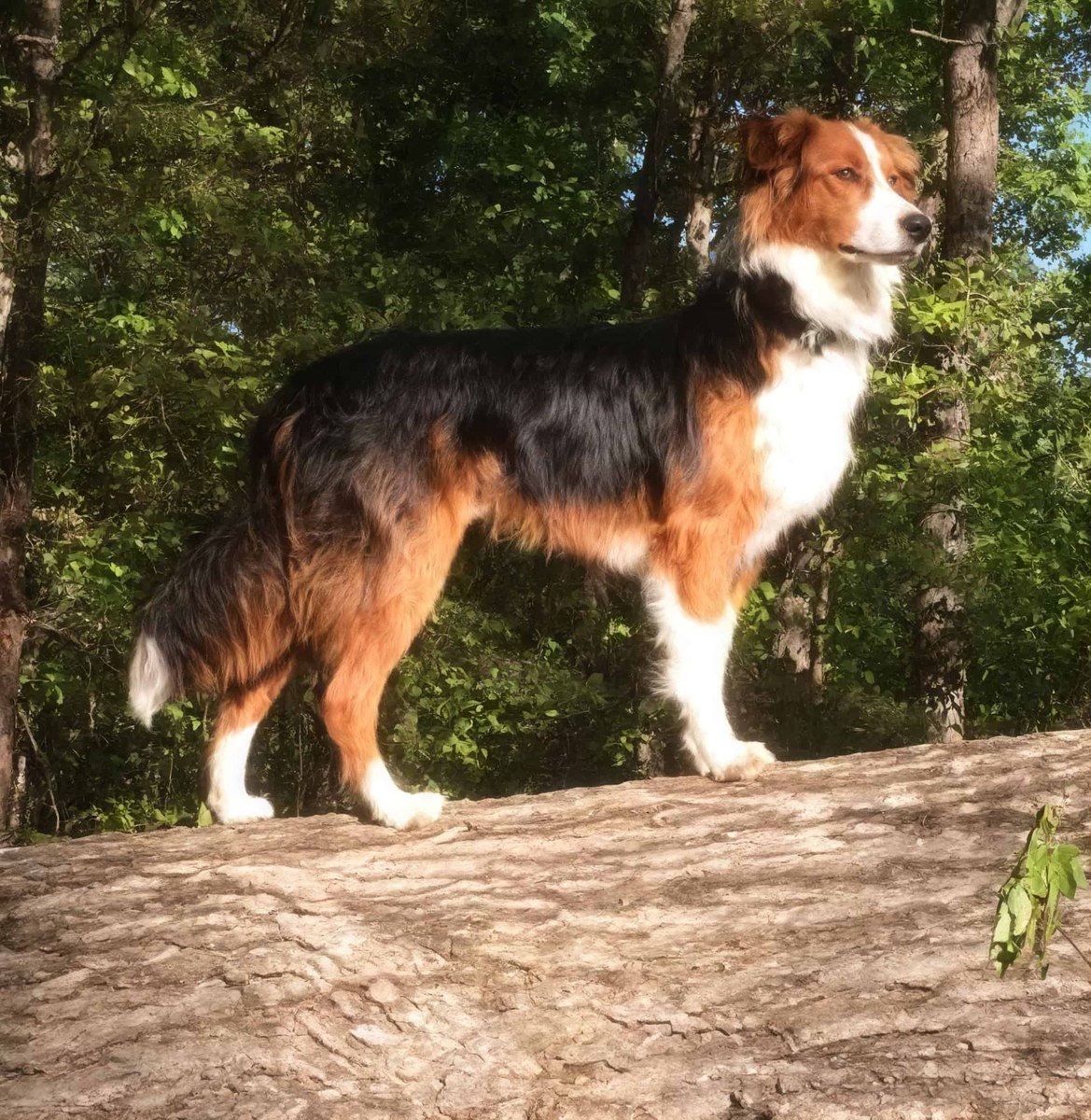
The English Shepherd is a medium-sized dog — substantial enough to work livestock without being too large to be agile. Males typically range from 45 to 65 pounds and stand 19 to 23 inches at the shoulder. Females are somewhat lighter, usually between 40 and 50 pounds.
Their coat is long and either straight, wavy, or gently curly, with feathering on the legs, chest, and tail. It is a working coat — protective in the field, but not overly high-maintenance. Regular brushing keeps them looking their best, with heavier shedding in spring and fall.
English Shepherds come in four traditional color patterns: black and white, black and tan, sable and white, and tricolor (black, white, and tan). Shades of red, gold, and sable are also seen throughout the breed. Our dogs at Hickory Hill carry sable, tricolor, and red and white lines.

Staying Healthy
One of the genuine advantages of the English Shepherd is its overall hardiness compared to many more popular breeds. Because the breed has never been heavily show-bred or narrowed to a small gene pool by fashion, it has largely avoided the serious genetic health problems that plague breeds like Golden Retrievers, German Shepherds, and even Border Collies.
English Shepherds are generally long-lived, athletic, and sound. Many breeders raise them as naturally as possible — good food, plenty of outdoor exercise, and minimal chemical intervention — and find that the dogs thrive on that approach.
One health note worth knowing: some English Shepherds carry the MDR1 genetic mutation, which causes sensitivity to certain drugs including ivermectin (a common dewormer). Responsible breeders test for this and can provide results. It is manageable and does not affect day-to-day health — it simply requires awareness when choosing medications.
Is This the Right Dog for You?
We'd love to talk with you about whether an English Shepherd is the right fit for your home. Reach out and tell us about yourself.
Get in TouchInformation on this page was drawn from and informed by the following sources: